The Invention of Photograph in the 19th Century Essentially Democratized the Art of Portraiture
| Egyptian | ||||||
|---|---|---|---|---|---|---|
| ||||||
| Region | Originally, throughout Ancient Egypt and parts of Nubia (especially during the times of the Nubian kingdoms)[2] | |||||
| Ethnicity | Ancient Egyptians Northern Aboriginal Nubians [2] | |||||
| Era | Tardily 4th millennium BC – 19th century AD[iii] (with the extinction of Coptic); notwithstanding used as the liturgical language of the Coptic Orthodox and Coptic Catholic churches | |||||
| Linguistic communication family | Afro-Asiatic
| |||||
| Dialects |
| |||||
| Writing system | hieroglyphs, cursive hieroglyphs, hieratic, demotic and Coptic (later, occasionally, Standard arabic script in government translations and Latin script in scholars' transliterations and several hieroglyphic dictionaries[6]) | |||||
| Language codes | ||||||
| ISO 639-two | egy (besides cop for Coptic) | |||||
| ISO 639-three | egy (also cop for Coptic) | |||||
| Glottolog | egyp1246 | |||||
| Linguasphere | 11-AAA-a | |||||
 Ebers Papyrus detailing treatment of asthma | ||||||


The Egyptian linguistic communication or Ancient Egyptian (Ancient Egyptian: 𓂋𓏺𓈖 𓆎𓅓𓏏𓊖 r n km.t )[1] [7] is an extinct Afro-Asiatic language that was spoken in ancient Arab republic of egypt. It is known today from a large corpus of surviving texts which were made accessible to the mod world following the decipherment of the ancient Egyptian scripts in the early 19th century. Egyptian is ane of the earliest written languages, starting time beingness recorded in the hieroglyphic script in the late quaternary millennium BC. It is likewise the longest-attested human linguistic communication, with a written record spanning over 4000 years.[8] Its classical form is known equally Middle Egyptian, the vernacular of the Center Kingdom of Egypt which remained the literary linguistic communication of Egypt until the Roman menses. Past the time of classical artifact the spoken linguistic communication had evolved into Demotic, and by the Roman era it had diversified into the Coptic dialects. These were eventually supplanted by Arabic later the Muslim conquest of Arab republic of egypt, although Bohairic Coptic remains in use as the liturgical language of the Coptic Church.[ix] [3]
Nomenclature [edit]
The Egyptian language belongs to the Afroasiatic linguistic communication family.[ten] [11] Amid the typological features of Egyptian that are typically Afroasiatic are its fusional morphology, nonconcatenative morphology, a series of emphatic consonants, a 3-vowel system /a i u/, nominal feminine suffix *-at, nominal m-, adjectival *-ī and characteristic personal verbal affixes.[10] Of the other Afroasiatic branches, linguists have variously suggested that the Egyptian linguistic communication shares its greatest affinities with Berber[12] and Semitic[xi] [thirteen] [14] languages, particularly Hebrew.[11]Notwithstanding, other scholars accept argued that the Ancient Egyptian language shared closer linguistic ties with north-eastern African regions.[15] [16] [17]
In Egyptian, the Proto-Afroasiatic voiced consonants */d z ð/ adult into pharyngeal ⟨ꜥ⟩ /ʕ/: Egyptian ꜥr.t 'portal', Semitic dalt 'door'. Afroasiatic */fifty/ merged with Egyptian ⟨n⟩, ⟨r⟩, ⟨ꜣ⟩, and ⟨j⟩ in the dialect on which the written language was based, only it was preserved in other Egyptian varieties. Original */k g ḳ/ palatalise to ⟨ṯ j ḏ⟩ in some environments and are preserved every bit ⟨grand g q⟩ in others.[18]
The Egyptian linguistic communication has many biradical and possibly monoradical roots, in dissimilarity to the Semitic preference for triradical roots. Egyptian is probably more than bourgeois, and Semitic likely underwent later regularizations converting roots into the triradical pattern.[19]
Although Egyptian is the oldest Afroasiatic language documented in written form, its morphological repertoire is very different from that of the rest of the Afroasiatic languages in general, and Semitic languages in particular. There are multiple possibilities: Egyptian had already undergone radical changes from Proto-Afroasiatic before information technology was recorded; the Afroasiatic family has then far been studied with an excessively Semito-centric approach; or, equally G. Westward. Tsereteli suggests, Afroasiatic is an allogenetic rather than a genetic grouping of languages.[20]
History [edit]
The Egyptian language is conventionally grouped into vi major chronological divisions:[21]
- Archaic Egyptian (before 2600 BC), the reconstructed language of the Early Dynastic Period,
- Former Egyptian (c. 2600 – 2000 BC), the language of the Old Kingdom,
- Middle Egyptian (c. 2000 – 1350 BC), the language of the Middle Kingdom to early New Kingdom and continuing on as a literary linguistic communication into the 4th century,
- Tardily Egyptian (c. 1350 – 700 BC), Amarna period to Third Intermediate Period,
- Demotic (c. 700 BC – AD 400), the colloquial of the Late Menses, Ptolemaic and early Roman Egypt,
- Coptic (after c. 200 Advert), the vernacular at the fourth dimension of Christianisation, and liturgical linguistic communication of Egyptian Christianity.
Old, Middle, and Belatedly Egyptian were all written using both the hieroglyphic and hieratic scripts. Demotic is the proper noun of the script derived from hieratic kickoff in the seventh century BC.
The Coptic alphabet was derived from the Greek alphabet, with adaptations for Egyptian phonology. It was first developed in the Ptolemaic catamenia, and gradually replaced the Demotic script in about the 4th to 5th centuries of the Christian era.
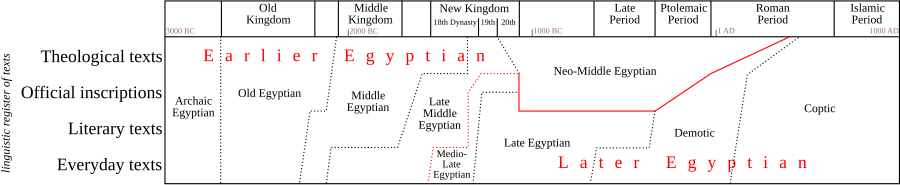
Diagram showing the use of the various lects of Egyptian past time period and linguistic annals.
One-time Egyptian [edit]
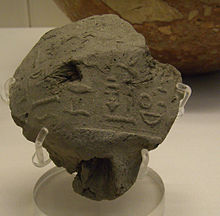
Seal impression from the tomb of Seth-Peribsen, containing the oldest known complete sentence in Egyptian
The term "Archaic Egyptian" is sometimes reserved for the earliest employ of hieroglyphs, from the late fourth through the early third millennia BC. At the earliest stage, around 3300 BC,[22] hieroglyphs were not a fully developed writing system, beingness at a transitional stage of proto-writing; over the fourth dimension leading upward to the 27th century BC, grammatical features such as nisba formation can be seen to occur.[23] [24]
Old Egyptian is dated from the oldest known complete sentence, including a finite verb, which has been constitute. Discovered in the tomb of Seth-Peribsen (dated c. 2690 BC), the seal impression reads:
All-encompassing texts appear from well-nigh 2600 BC.[24] The Pyramid Texts are the largest body of literature written in this phase of the language. One of its distinguishing characteristics is the tripling of ideograms, phonograms, and determinatives to indicate the plural. Overall, it does non differ significantly from Middle Egyptian, the classical stage of the language, though it is based on a different dialect.
In the period of the tertiary dynasty (c. 2650 – c. 2575 BC), many of the principles of hieroglyphic writing were regularized. From that fourth dimension on, until the script was supplanted by an early on version of Coptic (about the third and 4th centuries), the organisation remained virtually unchanged. Even the number of signs used remained abiding at nigh 700 for more than 2000 years.[27]
Middle Egyptian [edit]
Middle Egyptian was spoken for about 700 years, beginning around 2000 BC.[13] As the classical variant of Egyptian, Middle Egyptian is the all-time-documented variety of the language, and has attracted the nearly attention by far from Egyptology. Whilst nearly Eye Egyptian is seen written on monuments by hieroglyphs, it was also written using a cursive variant, and the related hieratic.[28]
Center Egyptian first became available to modern scholarship with the decipherment of hieroglyphs in the early 19th century. The first grammer of Middle Egyptian was published by Adolf Erman in 1894, surpassed in 1927 past Alan Gardiner's work. Middle Egyptian has been well-understood since and so, although certain points of the verbal inflection remained open to revision until the mid-20th century, notably due to the contributions of Hans Jakob Polotsky.[29]
The Eye Egyptian phase is taken to take concluded effectually the 14th century BC, giving ascension to Late Egyptian. This transition was taking identify in the later catamenia of the Eighteenth Dynasty of Egypt (known as the Amarna Period). Middle Egyptian was retained as a literary standard language, and in this usage survived until the Christianisation of Roman Egypt in the 4th century.[ commendation needed ]
Tardily Egyptian [edit]
Late Egyptian, appearing effectually 1350 BC, is represented by a large body of religious and secular literature, comprising such examples every bit the Story of Wenamun, the beloved poems of the Chester–Beatty I papyrus, and the Instruction of Whatever. Instructions became a popular literary genre of the New Kingdom, which took the grade of advice on proper behavior. Late Egyptian was besides the language of New Kingdom assistants.[7] [30]
The Hebrew Bible contains some words, terms and names that are thought by scholars to be Egyptian in origin. An instance of this is Zaphnath-Paaneah, the Egyptian name given to Joseph.
Demotic and Coptic [edit]

10th century stela with Coptic inscription, in the Louvre
Demotic is the proper name given to the Egyptian script used to write both the Egyptian colloquial of the Late Menstruation from the eight century BC too as texts in archaic forms of the language. It was written in a script derived from a northern variety of hieratic writing. The final show of archaic Egyptian in Demotic is a graffito written in 452 BC, simply Demotic was used to write vernacular before and in parallel with the Coptic script throughout the early Ptolemaic Kingdom until it was supplanted by the Coptic alphabet entirely.[31]
Coptic is the name given to the tardily Egyptian colloquial when it was written in a Greek-based alphabet, the Coptic alphabet; it flourished from the time of Early on Christianity (c. 31/33–324) but first appeared during the Hellenistic period c. third century BC.[32] It survived into the medieval period.
Past the 16th century Coptic was dwindling rapidly due to the persecution of Coptic Christians under the Mamluks. It probably survived in the Egyptian countryside equally a spoken language for several centuries afterwards that. Coptic survives as the liturgical language of the Coptic Orthodox Church and the Coptic Cosmic Church.
Dialects [edit]
About hieroglyphic Egyptian texts are written in a literary prestige annals rather than the vernacular speech variety of their author. As a result, dialectical differences are not apparent in written Egyptian until the adoption of the Coptic alphabet.[iv] [5] Nevertheless, it is clear that these differences existed before the Coptic menses. In one Belatedly Egyptian letter (dated c. 1200 BC), a scribe jokes that his colleague's writing is incoherent like "the speech of a Delta man with a man of Elephantine."[four] [5]
Recently, some prove of internal dialects has been found in pairs of similar words in Egyptian that, based on similarities with later dialects of Coptic, may be derived from northern and southern dialects of Egyptian.[33] Written Coptic has 5 major dialects, which differ mainly in graphic conventions, about notably the southern Saidic dialect, the main classical dialect, and the northern Bohairic dialect, currently used in Coptic Church services.[4] [5]
Writing systems [edit]
Most surviving texts in the Egyptian linguistic communication are written on stone in hieroglyphs. The native name for Egyptian hieroglyphic writing is zẖꜣ due north mdw-nṯr ("writing of the gods' words").[34] [ citation needed ] In antiquity, near texts were written on perishable papyrus in hieratic and (subsequently) demotic. At that place was as well a form of cursive hieroglyphs, used for religious documents on papyrus, such as the Book of the Expressionless of the Twentieth Dynasty; it was simpler to write than the hieroglyphs in stone inscriptions, but it was not equally cursive as hieratic and lacked the wide utilise of ligatures. Additionally, there was a variety of stone-cut hieratic, known as "lapidary hieratic".[ citation needed ] In the linguistic communication'southward terminal phase of evolution, the Coptic alphabet replaced the older writing organization.
Hieroglyphs are employed in two means in Egyptian texts: as ideograms to represent the idea depicted by the pictures and, more than commonly, equally phonograms to represent their phonetic value.
Every bit the phonetic realisation of Egyptian cannot be known with certainty, Egyptologists employ a system of transliteration to denote each sound that could be represented by a uniliteral hieroglyph.[35]
Phonology [edit]
While the consonantal phonology of the Egyptian language may be reconstructed, the exact phonetics are unknown, and there are varying opinions on how to classify the individual phonemes. In addition, because Egyptian is recorded over a full 2000 years, the Archaic and Late stages being separated past the amount of fourth dimension that separates Old Latin from Modern Italian, pregnant phonetic changes must have occurred during that lengthy fourth dimension frame.[36]
Phonologically, Egyptian contrasted labial, alveolar, palatal, velar, uvular, pharyngeal, and glottal consonants. Egyptian also assorted voiceless and emphatic consonants, as with other Afroasiatic languages, but exactly how the emphatic consonants were realised is unknown. Early enquiry had assumed that the opposition in stops was i of voicing, but it is at present thought to be either one of tenuis and emphatic consonants, as in many Semitic languages, or one of aspirated and ejective consonants, every bit in many Cushitic languages.[37]
Since vowels were non written until Coptic, reconstructions of the Egyptian vowel organisation are much more uncertain and rely mainly on evidence from Coptic and records of Egyptian words, especially proper nouns, in other languages/writing systems. Also, scribal errors provide bear witness of changes in pronunciation over time.[ citation needed ]
The actual pronunciations reconstructed by such means are used only past a few specialists in the language. For all other purposes, the Egyptological pronunciation is used, but it often bears footling resemblance to what is known of how Egyptian was pronounced.
Consonants [edit]
The following consonants are reconstructed for Archaic (before 2600 BC) and Former Egyptian (2686–2181 BC), with IPA equivalents in square brackets if they differ from the usual transcription scheme:
| Labial | Alveolar | Postalveolar | Palatal | Velar | Uvular | Pharyngeal | Glottal | ||
|---|---|---|---|---|---|---|---|---|---|
| Nasal | grand | north | |||||||
| Stop | voiceless | p | t | ṯ [c] | k | q* | ʔ | ||
| voiced | b | d* | ḏ* [ɟ] | ɡ* | |||||
| Fricative | voiceless | f | southward | š [ʃ] | ẖ [ç] | ḫ [χ] | ḥ [ħ] | h | |
| voiced | z* | ꜣ (ȝ) [ʁ] | ꜥ (ʿ) [ʕ] | ||||||
| Approximant | w | 50 | j | ||||||
| Trill | r | ||||||||
*Perhaps unvoiced ejectives.
/l/ has no independent representation in the hieroglyphic orthography, and it is oftentimes written as if information technology were /n/ or /r/.[38] That is probably considering the standard for written Egyptian is based on a dialect in which /l/ had merged with other sonorants.[18] Also, the rare cases of /ʔ/ occurring are not represented. The phoneme /j/ is written as ⟨j⟩ in initial position (⟨jt⟩ = */ˈjaːtVj/ 'male parent') and immediately after a stressed vowel (⟨bjn⟩ = */ˈbaːjin/ 'bad') and as ⟨jj⟩ word-medially immediately before a stressed vowel (⟨ḫꜥjjk⟩ = */χaʕˈjak/ 'you will announced') and are unmarked word-finally (⟨jt⟩ = /ˈjaːtVj/ 'father').[38]
In Eye Egyptian (2055–1650 BC), a number of consonantal shifts take identify. By the start of the Middle Kingdom period, /z/ and /south/ had merged, and the graphemes ⟨south⟩ and ⟨z⟩ are used interchangeably.[39] In improver, /j/ had become /ʔ/ give-and-take-initially in an unstressed syllable (⟨jwn⟩ /jaˈwin/ > */ʔaˈwin/ "colour") and after a stressed vowel (⟨ḥjpw⟩ */ˈħujpVw/ > /ˈħeʔp(Vw)/ '[the god] Apis').[twoscore]
In Tardily Egyptian (1069–700 BC), the phonemes d ḏ chiliad gradually merge with their counterparts t ṯ thousand (⟨dbn⟩ */ˈdiːban/ > Akkadian transcription ti-ba-an 'dbn-weight'). Also, ṯ ḏ often get /t d/, but they are retained in many lexemes; ꜣ becomes /ʔ/; and /t r j w/ go /ʔ/ at the end of a stressed syllable and eventually cipher give-and-take-finally: ⟨pḏ.t⟩ */ˈpiːɟat/ > Akkadian transcription -pi-ta 'bow'.[41]
More changes occur in the 1st millennium BC and the first centuries Advertisement, leading to Coptic (1st–17th centuries AD). In Sahidic ẖ ḫ ḥ had merged into ϣ š (near often from ḫ) and ϩ /h/ (nearly often ẖ ḥ). Bohairic and Akhmimic are more conservative and have a velar fricative /10/ (ϧ in Bohairic, ⳉ in Akhmimic).[42] Pharyngeal *ꜥ had merged into glottal /ʔ/ after information technology had afflicted the quality of the surrounding vowels.[43] /ʔ/ is non indicated orthographically unless information technology follows a stressed vowel; so, information technology is marked by doubling the vowel letter (except in Bohairic): Akhmimic ⳉⲟⲟⲡ /xoʔp/, Sahidic and Lycopolitan ϣⲟⲟⲡ šoʔp, Bohairic ϣⲟⲡ šoʔp 'to exist' < ḫpr.w */ˈχapraw/ 'has get'.[42] [nb 1] The phoneme ⲃ /b/ was probably pronounced every bit a fricative [β], becoming ⲡ /p/ after a stressed vowel in syllables that had been closed in earlier Egyptian (compare ⲛⲟⲩⲃ < */ˈnaːbaw/ 'gold' and ⲧⲁⲡ < */dib/ 'horn').[42] The phonemes /d g z/ occur just in Greek loanwords, with rare exceptions triggered by a nearby /n/: ⲁⲛⲍⲏⲃⲉ/ⲁⲛⲥⲏⲃⲉ < ꜥ.t north.t sbꜣ.w 'school'.[42]
Earlier *d ḏ thou q are preserved as ejective t' c' k' k' before vowels in Coptic. Although the aforementioned graphemes are used for the pulmonic stops (⟨ⲧ ϫ ⲕ⟩), the being of the one-time may exist inferred considering the stops ⟨ⲡ ⲧ ϫ ⲕ⟩ /p t c k/ are allophonically aspirated [pʰ tʰ cʰ kʰ] before stressed vowels and sonorant consonants.[44] In Bohairic, the allophones are written with the special graphemes ⟨ⲫ ⲑ ϭ ⲭ⟩, but other dialects did not marking aspiration: Sahidic ⲡⲣⲏ, Bohairic ⲫⲣⲏ 'the sun'.[44] [nb ii]
Thus, Bohairic does not marking aspiration for reflexes of older *d ḏ g q: Sahidic and Bohairic ⲧⲁⲡ */dib/ 'horn'.[44] Besides, the definite article ⲡ is unaspirated when the next discussion begins with a glottal stop: Bohairic ⲡ + ⲱⲡ > ⲡⲱⲡ 'the business relationship'.[45]
The consonant system of Coptic is as follows:
| Labial | Dental | Palatal | Velar | Glottal | ||
|---|---|---|---|---|---|---|
| Nasal | ⲙ thousand | ⲛ n | ||||
| End | voiceless | ⲡ (ⲫ) p (pʰ) | ⲧ (ⲑ) t (tʰ) | ϫ (ϭ) c (cʰ) | ⲕ (ⲭ) thou (kʰ) | * ʔ |
| ejective | ⲧ tʼ | ϫ cʼ | ⲕ kʼ | |||
| voiced | ⲇ d | ⲅ ɡ | ||||
| Fricative | voiceless | ϥ f | ⲥ due south | ϣ ʃ | (ϧ, ⳉ) (10) | ϩ h |
| voiced | ⲃ β | ⲍ z | ||||
| Approximant | (ⲟ)ⲩ west | ⲗ fifty | (ⲉ)ⲓ j | |||
| Trill | ⲣ r | |||||
*Various orthographic representations; come across above.
Vowels [edit]
Here is the vowel organisation reconstructed for earlier Egyptian:
| Front | Back | |
|---|---|---|
| Close | i iː | u uː |
| Open | a aː | |
Vowels are e'er short in unstressed syllables (⟨tpj⟩ = */taˈpij/ 'first') and long in open up stressed syllables (⟨rmṯ⟩ = */ˈraːmac/ 'man'), only they can be either curt or long in closed stressed syllables (⟨jnn⟩ = */jaˈnan/ 'we', ⟨mn⟩ = */maːn/ 'to stay').[47]
In the Belatedly New Kingdom, afterwards Ramses II, effectually 1200 BC, */ˈaː/ changes to */ˈoː/ (similar the Canaanite shift), ⟨ḥrw⟩ '(the god) Horus' */ħaːra/ > */ħoːrə/ (Akkadian transcription: -ḫuru).[41] [48] */uː/, therefore, changes to */eː/: ⟨šnj⟩ 'tree' */ʃuːn(?)j/ > */ʃeːnə/ (Akkadian transcription: -sini).[41]
In the Early New Kingdom, short stressed */ˈi/ changes to */ˈe/: ⟨mnj⟩ "Menes" */maˈnij/ > */maˈneʔ/ (Akkadian transcription: ma-né-eastward).[41] Later, probably one thousand–800 BC, a brusque stressed */ˈu/ changes to */ˈe/: ⟨ḏꜥn.t⟩ "Tanis" */ˈɟuʕnat/ was borrowed into Hebrew as *ṣuʕn only would become transcribed as ⟨ṣe-e'-nu/ṣa-a'-nu⟩ during the Neo-Assyrian Empire.[49]
Unstressed vowels, especially after a stress, become */ə/: ⟨nfr⟩ 'good' */ˈnaːfir/ > */ˈnaːfə/ (Akkadian transcription -na-a-pa).[49] */iː/ changes to */eː/ next to /ʕ/ and /j/: ⟨wꜥw⟩ 'soldier' */wiːʕiw/ > */weːʕə/ (earlier Akkadian transcription: ú-i-ú, later on: ú-e-eḫ).[49]
| Forepart | Central | Back | |
|---|---|---|---|
| Close | iː | ||
| Mid | east eː | ə | oː |
| Open | a | ||
In Sahidic and Bohairic Coptic, Belatedly Egyptian stressed */ˈa/ becomes */ˈo/ and */ˈe/ becomes /ˈa/, simply are unchanged in the other dialects: ⟨sn⟩ */san/ 'brother' > Sahaidic and Bohairic ⟨son⟩, Akhminic, Lycopolitan and Fayyumic ⟨san⟩; ⟨rn⟩ 'name' */rin/ > */ren/ > Sahaidic and Bohairic ⟨ran⟩, Akhminic, Lycopolitan and Fayyumic ⟨ren⟩.[43] Yet, Sahaidic and Bohairic preserve */ˈa/, and Fayyumic renders it as ⟨e⟩ in the presence of guttural fricatives: ⟨ḏbꜥ⟩ '10 thousand' */ˈbaʕ/ > Sahaidic, Akhmimic and Lycopolitan ⟨tba⟩, Bohairic ⟨tʰba⟩, Fayyumic ⟨tbe⟩. In Akhmimic and Lycopolitan, */ˈa/ becomes /ˈo/ before etymological /ʕ, ʔ/: ⟨jtrw⟩ 'river' */ˈjatraw/ > */jaʔr(ə)/ > Sahaidic ⟨eioor(e)⟩, Bohairic ⟨ior⟩, Akhminic ⟨ioore, iôôre⟩, Fayyumic ⟨iaal, iaar⟩. Similarly, the diphthongs */ˈaj/, */ˈaw/, which normally have reflexes /ˈoj/, /ˈow/ in Sahidic and are preserved in other dialects, are in Bohairic ⟨ôi⟩ (in non-last position) and ⟨ôou⟩ respectively: "to me, to them" Sahidic ⟨eroi, eroou⟩, Akhminic and Lycopolitan ⟨arai, arau⟩, Fayyumic ⟨elai, elau⟩, Bohairic ⟨eroi, erôou⟩. Sahidic and Bohairic preserve */ˈe/ before /ʔ/ (etymological or from lenited /t r j/ or tonic-syllable coda /w/),: Sahidic and Bohairic ⟨ne⟩ /neʔ/ 'to you (fem.)' < */ˈnet/ < */ˈnic/. */e/ may also have dissimilar reflexes before sonorants, near sibilants and in diphthongs.[50]
Quondam */aː/ surfaces equally /uː/ subsequently nasals and occasionally other consonants: ⟨nṯr⟩ 'god' */ˈnaːcar/ > /ˈnuːte/ ⟨noute⟩[51] /uː/ has acquired phonemic status, as is evidenced by minimal pairs like 'to approach' ⟨hôn⟩ /hoːn/ < */ˈçaːnan/ ẖnn vs. 'inside' ⟨houn⟩ /huːn/ < */ˈçaːnaw/ ẖnw.[52] An etymological */uː/ > */eː/ often surfaces every bit /iː/ next to /r/ and after etymological pharyngeals: ⟨hir⟩ < */χuːr/ 'street' (Semitic loan).[52]
Most Coptic dialects have two phonemic vowels in unstressed position. Unstressed vowels generally became /ə/, written as ⟨e⟩ or zilch (⟨i⟩ in Bohairic and Fayyumic word-finally), merely pretonic unstressed /a/ occurs as a reflex of before unstressed */e/ near an etymological pharyngeal, velar or sonorant ('to go many' ⟨ašai⟩ < ꜥšꜣ */ʕiˈʃiʀ/) or an unstressed */a/. Pretonic [i] is underlyingly /əj/: Sahidic 'ibis' ⟨hibôi⟩ < h(j)bj.w */hijˈbaːj?west/.[52]
Thus, the following is the Sahidic vowel system c. Ad 400:
| Stressed | Unstressed | ||
|---|---|---|---|
| Front | Back | Central | |
| Shut | iː | uː | |
| Mid | due east eː | o oː | ə |
| Open | a | ||
Phonotactics [edit]
Earlier Egyptian has the syllable construction CV(:)(C) in which V is long in open stressed syllables and short elsewhere.[47] In improver, CV:C or CVCC can occur in word-last, stressed position.[47] However, CV:C occurs only in the infinitive of biconsonantal verbal roots, CVCC only in some plurals.[47] [49]
In later Egyptian, stressed CV:C, CVCC, and CV go much more than mutual considering of the loss of concluding dentals and glides.[49]
Stress [edit]
Before Egyptian stresses one of the last two syllables. According to some scholars, that is a development from a stage in Proto-Egyptian in which the 3rd-last syllable could exist stressed, which was lost as open posttonic syllables lost their vowels: */ˈχupiraw/ > */ˈχupraw/ 'transformation'.[53]
Egyptological pronunciation [edit]
As a convention, Egyptologists brand use of an "Egyptological pronunciation" in English: the consonants are given fixed values, and vowels are inserted according to essentially arbitrary rules. Two of these consonants known as alef and ayin are generally pronounced equally the vowel /ɑː/. Yodh is pronounced /iː/, w /uː/. Between other consonants, /ɛ/ is then inserted. Thus, for example, the Egyptian name Ramesses is most accurately transliterated as Rꜥ-ms-sw and transcribed every bit "Rɑmɛssu"; it means "Ra has Fashioned (literally, 'Borne') Him".
In transcription, ⟨a⟩, ⟨i⟩, and ⟨u⟩ all correspond consonants; for example, the proper name Tutankhamun (1341–1323 BC) was written in Egyptian as twt-ꜥnḫ-ı͗mn. Experts accept assigned generic sounds to these values as a matter of convenience, which is an artificial pronunciation and should not exist mistaken for how Egyptian was ever pronounced at any time. For instance, the name twt-ꜥnḫ-ı͗mn is conventionally pronounced in English, but, in his lifetime, it was likely to be pronounced something similar * [təˈwaːtəʔ ˈʕaːnəχ ʔaˈmaːnəʔ],[54] [55] [56] [57] [58] [59] transliterable as təwā́təʾ-ʿā́nəkh-ʾamā́nəʾ.
Morphology [edit]
Egyptian is fairly typical for an Afroasiatic language in that at the centre of its vocabulary is nigh unremarkably a root of three consonants, simply there are sometimes just two consonants in the root: rꜥ(west) [riːʕa] "dominicus" (the [ʕ] is thought to accept been something like a voiced pharyngeal fricative). Larger roots are as well common and can have upward to v consonants: sḫdḫd "be upside-down".
Vowels and other consonants are added to the root to derive different meanings, as Arabic, Hebrew, and other Afroasiatic languages nonetheless do. Nevertheless, because vowels and sometimes glides are non written in any Egyptian script except Coptic, it can exist hard to reconstruct the actual forms of words. Thus, orthographic ⟨stp⟩ "to choose", for example, can represent the stative (whose endings can be left unexpressed), the imperfective forms or fifty-fifty a verbal noun ("a choosing").
Nouns [edit]
Egyptian nouns can be masculine or feminine (the latter is indicated, equally with other Afroasiatic languages, by adding a -t) and singular or plural (-due west / -wt), or dual (-wy / -ty).
Articles, both definite and indefinite, do not occur until Late Egyptian merely are used widely thereafter.
Pronouns [edit]
Egyptian has three different types of personal pronouns: suffix, enclitic (chosen "dependent" past Egyptologists) and independent pronouns. There are also a number of verbal endings added to the infinitive to form the stative and are regarded past some linguists[sixty] as a "quaternary" set of personal pronouns. They bear close resemblance to their Semitic counterparts. The three main sets of personal pronouns are as follows:
| Suffix | Dependent | Independent | |
|---|---|---|---|
| 1st sg. | -ı͗ | wı͗ | ı͗nk |
| second sg. chiliad. | -g | tw | ntk |
| 2nd sg. f. | -t | tn | ntt |
| 3rd sg. m. | -f | sw | ntf |
| 3rd sg. f. | -s | sy | nts |
| 1st pl. | -n | northward | ı͗nn |
| 2nd pl. | -tn | tn | nttn |
| 3rd pl. | -sn | sn | ntsn |
Demonstrative pronouns take split up masculine and feminine singular forms and common plural forms for both genders:
| Mas. | Fem. | Plu. | Pregnant |
|---|---|---|---|
| pn | tn | nn | this, that, these, those |
| pf | tf | nf | that, those |
| pw | tw | nw | this, that, these, those (archaic) |
| pꜣ | tꜣ | nꜣ | this, that, these, those (colloquial [earlier] & Belatedly Egyptian) |
Finally are interrogative pronouns. They acquit a close resemblance to their Semitic and Berber counterparts:
| Pronoun | Meaning | Dependency |
|---|---|---|
| mı͗ | who / what | Dependent |
| ptr | who / what | Independent |
| iḫ | what | Dependent |
| ı͗šst | what | Independent |
| zı͗ | which | Independent & Dependent |
Verbs [edit]
Egyptian verbs accept finite and non-finite forms.
Finite verbs convey person, tense/aspect, mood and vocalism. Each is indicated past a set of affixal morphemes fastened to the verb: the basic conjugation is sḏm.f "he hears".
Non-finite verbs occur without a subject and are the infinitive, the participles and the negative infinitive, which Egyptian Grammar: Existence an Introduction to the Written report of Hieroglyphs calls "negatival complement". There are two master tenses/aspects in Egyptian: past and temporally-unmarked imperfective and aorist forms. The latter are determined from their syntactic context.
Adjectives [edit]
Adjectives agree in gender and number with the nouns they modify: due south nfr "(the) good man" and st nfrt "(the) good woman".
Attributive adjectives in phrases are after the nouns they alter: "(the) great god" (nṯr ꜥꜣ).
However, when they are used independently equally a predicate in an adjectival phrase, as "(the) god (is) swell" (ꜥꜣ nṯr) (literally, "great (is the) god"), adjectives precede the nouns they change.
Prepositions [edit]
Egyptian makes use of prepositions.
| one thousand | "in, as, with, from" |
| n | "to, for" |
| r | "to, at" |
| ı͗n | "by" |
| ḥnꜥ | "with" |
| mı͗ | "like" |
| ḥr | "on, upon" |
| ḥꜣ | "behind, effectually" |
| ẖr | "under" |
| tp | "atop" |
| ḏr | "since" |
Adverbs [edit]
Adverbs, in Egyptian, are at the end of a sentence: in zı͗.n nṯr ı͗m "the god went at that place", "there" (ı͗m) is the adverb. Here are some other mutual Egyptian adverbs:
| ꜥꜣ | "here" |
| ṯnı͗ | "where" |
| zy-nw | "when" (lit. "which moment") |
| mı͗-ı͗ḫ | "how" (lit. "like-what") |
| r-mı͗ | "why" (lit. "for what") |
| ḫnt | "before" |
Syntax [edit]
Old Egyptian, Classical Egyptian, and Middle Egyptian take verb-subject area-object as the basic word order. However, that changed in the later stages of the language, including Late Egyptian, Demotic and Coptic.
The equivalent to "the man opens the door" would exist a judgement that would correspond, in the language's earlier stages, to "opens the man the door" (wn s ꜥꜣ). The and so-chosen construct land combines ii or more nouns to express the genitive, as in Semitic and Berber languages.
The early stages of Egyptian have no articles, simply the later forms use pꜣ, tꜣ and nꜣ. Equally with other Afroasiatic languages, Egyptian uses two grammatical genders: masculine and feminine. It too uses three grammatical numbers: singular, dual and plural. However, after Egyptian has a tendency to lose the dual as a productive form.
Legacy [edit]
The Egyptian language survived through the Heart Ages and into the early modern period in the course of the Coptic language. Coptic survived past the 16th century merely as an isolated vernacular and as a liturgical language for the Coptic Orthodox and Coptic Catholic Churches. Coptic also had an indelible effect on Egyptian Arabic, which replaced Coptic as the chief daily language in Arab republic of egypt; the Coptic substratum in Egyptian Arabic appears in certain aspects of syntax and to a lesser degree in vocabulary and phonology.
In artifact, Egyptian exerted some influence on Classical Greek, and then that a number of Egyptian loanwords into Greek survive into mod usage. Examples include ebony (Egyptian 𓍁𓈖𓏭𓆱 hbny, via Greek so Latin), ivory (Egyptian ꜣbw, literally "ivory, elephant"), natron (via Greek), lily (Coptic hlēri, via Greek), ibis (Egyptian hbj, via Greek), haven (Demotic wḥj, via Greek), perhaps barge (Greek βᾶρις baris "Egyptian boat" from Coptic ⲃⲁⲁⲣⲉ baʔrə "small boat" from Egyptian bꜣjr ), and perhaps cat;[61] and of form a number of terms and proper names directly associated with Ancient Egypt, such as pharaoh (Egyptian 𓉐𓉻 pr-ꜥꜣ, literally "corking house", transmitted via Hebrew and Greek). The name Egypt itself is etymologically identical to that of the Copts, ultimately from the Belatedly Egyptian name of Memphis, Hikuptah, a continuation of Middle Egyptian ḥwt-kꜣ-ptḥ "temple of the ka (soul) of Ptah".[62]
Run across besides [edit]
- Altägyptisches Wörterbuch
- Ancient Egyptian literature
- Coptic language
- Demotic Egyptian
- Egyptian Arabic
- Egyptian hieroglyphs
- Egyptian numerals
- Hieratic
- Transliteration of Ancient Egyptian
Notes [edit]
- ^ There is evidence of Bohairic having a phonemic glottal stop: Loprieno (1995:44).
- ^ In other dialects, the graphemes are used but for clusters of a stop followed past /h/ and were not used for aspirates: see Loprieno (1995:248).
References [edit]
- ^ a b Erman, Adolf; Grapow, Hermann, Wörterbuch der ägyptischen Sprache, Akademie-Verlag, Berlin, 1926–1961. ISBN 3050022647.
- ^ a b "Aboriginal Sudan~ Nubia: Writing: The Basic Languages of Christian Nubia: Greek, Coptic, Old Nubian, and Arabic". world wide web.ancientsudan.org. Archived from the original on 5 January 2009. Retrieved 9 March 2017.
{{cite spider web}}: CS1 maint: unfit URL (link) - ^ a b The language may have survived in isolated pockets in Upper Egypt equally late as the 19th century, co-ordinate to James Edward Quibell, "When did Coptic become extinct?" in Zeitschrift für ägyptische Sprache und Altertumskunde, 39 (1901), p. 87. In the village of Pi-Solsel (Az-Zayniyyah or El Zenya north of Luxor), passive speakers were recorded equally late every bit the 1930s, and traces of traditional vernacular Coptic reported to exist in other places such as Abydos and Dendera, see Werner Vycichl, Pi-Solsel, ein Dorf mit koptischer Überlieferung in: Mitteilungen des Deutschen Archäologischen Instituts, Abteilung Kairo, (MDAIK) vol. 6, 1936, pp. 169–175 (in German).
- ^ a b c d e Allen (2000:ii)
- ^ a b c d e Loprieno (1995:8)
- ^ https://www.um.es/cepoat/egipcio/wp-content/uploads/egyptianhierogly.pdf[ bare URL PDF ]
- ^ a b Loprieno (1995:vii)
- ^ Grossman, Eitan; Richter, Tonio Sebastian (2015). "The Egyptian-Coptic language: its setting in space, fourth dimension and culture". 'Egyptian-Coptic Linguistics in Typological Perspective. De Gruyter Mouton. p. 70. doi:10.1515/9783110346510.69. ISBN9783110346510.
The Egyptian-Coptic language is attested in a vast corpus of written texts that nearly uninterruptedly document its lifetime over more than 4000 years, from the invention of the hieroglyphic writing system in the late 4th millennium BCE, up to the 14th century CE. Egyptian is thus likely to be the longest-attested human being language known.
- ^ Layton, Benjamin (2007). Coptic in 20 Lessons: Introduction to Sahidic Coptic with Exercises & Vocabularies. Peeters Publishers. p. one. ISBN9789042918108.
The liturgy of the present 24-hour interval Coptic Orthodox Church in Egypt is written in a mixture of Arabic, Greek, and Bohairic Coptic, the ancient dialect of the Delta and the great monasteries of the Wadi Natrun. Coptic is no longer a living language.
- ^ a b Loprieno (1995:i)
- ^ a b c Rubin, Aaron D. (2013). "Egyptian and Hebrew". In Khan, Geoffrey; Bolozky, Shmuel; Fassberg, Steven; Rendsburg, Gary A.; Rubin, Aaron D.; Schwarzwald, Ora R.; Zewi, Tamar (eds.). Encyclopedia of Hebrew Language and Linguistics. Leiden and Boston: Brill Publishers. doi:10.1163/2212-4241_ehll_EHLL_COM_00000721. ISBN978-90-04-17642-three.
- ^ Frajzyngier, Zygmunt; Shay, Erin (31 May 2012). The Afroasiatic Languages. Cambridge University Press. p. 102. ISBN9780521865333.
- ^ a b Loprieno (1995:5)
- ^ Allan, Keith (2013). The Oxford Handbook of the History of Linguistics. OUP Oxford. p. 264. ISBN978-0199585847 . Retrieved 7 June 2018.
- ^ Ehret, Christopher (1996). Egypt in Africa. Indianapolis, Ind.: Indianapolis Museum of Fine art. pp. 25–27. ISBN0-936260-64-five.
- ^ Morkot, Robert (2005). The Egyptians : an introduction. New York: Routledge. p. 10. ISBN0415271045.
- ^ Mc Telephone call, Daniel F. (1998). "The Afroasiatic Language Phylum: African in Origin, or Asian?". Electric current Anthropology. 39 (1): 139–144. doi:10.1086/204702. ISSN 0011-3204.
- ^ a b Loprieno (1995:31)
- ^ Loprieno (1995:52)
- ^ Loprieno (1995:51)
- ^ Bard, Kathryn A.; Steven Blake Shubert (1999). Encyclopedia of the Archaeology of Ancient Egypt. Routledge. p. 325. ISBN978-0-415-18589-9.
- ^ Richard Mattessich, "Oldest writings, and inventory tags of Egypt", Accounting Historians Journal, 2002, Vol. 29, No. 1, pp. 195–208.
- ^ Richard Mattessich (2002). "The oldest writings, and inventory tags of Egypt". Accounting Historians Journal. 29 (1): 195–208. doi:x.2308/0148-4184.29.ane.195. JSTOR 40698264.
- ^ a b Allen (2013:2f.)
- ^ Werning, Daniel A. (2008) "Attribute vs. Relative Tense, and the Typological Classification of the Aboriginal Egyptian sḏm.due north⸗f" in Lingua Aegyptia sixteen, p. 289.
- ^ Allen (2013:ii) citing Jochem Kahl, Markus Bretschneider, Frühägyptisches Wörterbuch, Function 1 (2002), p. 229.
- ^ "Hieroglyph | writing grapheme". Encyclopedia Britannica . Retrieved 5 Dec 2018.
- ^ "Primeval Egyptian Glyphs – Archaeology Magazine Archive".
- ^ Polotsky, H. J., Études de syntaxe copte, Société d'Archéologie Copte, Cairo (1944); Polotsky, H. J., Egyptian Tenses, Israel Academy of Sciences and Humanities, Vol. ii, No. 5 (1965).
- ^ Meyers, op. cit., p. 209.
- ^ Allen, James (26 March 2020). Aboriginal Egyptian Phonology. Cambridge Academy Press. p. 23. ISBN978-1-108-48555-5.
- ^ Allen, James (26 March 2020). Ancient Egyptian Phonology. Cambridge University Press. p. iii. ISBN978-i-108-48555-5.
- ^ Satzinger (2008:10)
- ^ Schiffman, Lawrence H. (1 January 2003). Semitic Papyrology in Context: A Climate of Creativity : Papers from a New York University Conference Marking the Retirement of Baruch A. Levine. BRILL. ISBN978-9004128859.
- ^ Allen (2000:thirteen)
- ^ Lipiński, Eastward. (Edward) (2001). Semitic languages : outline of a comparative grammar. Peeters. ISBNxc-429-0815-7. OCLC 783059625.
- ^ See Egyptian Phonology, by Carsten Peust, for a review of the history of thinking on the subject; his reconstructions of words are nonstandard.
- ^ a b c Loprieno (1995:33)
- ^ Loprieno (1995:34)
- ^ a b Loprieno (1995:35)
- ^ a b c d Loprieno (1995:38)
- ^ a b c d Loprieno (1995:41)
- ^ a b c Loprieno (1995:46)
- ^ a b c Loprieno (1995:42)
- ^ Loprieno (1995:43)
- ^ Loprieno (1995:40–42)
- ^ a b c d Loprieno (1995:36)
- ^ Allen (2013)
- ^ a b c d e f Loprieno (1995:39)
- ^ Loprieno (1995:47)
- ^ Loprieno (1995:47–48)
- ^ a b c Loprieno (1995:48)
- ^ Loprieno (1995:37)
- ^ Fecht, Gerhard (1960). "§§ 112 A. 194, 254 A. 395". Wortakzent und Silbenstruktur: Untersuchungen zur Geschichte der ägyptischen Sprache. J. J. Augustin, Glückstadt–Hamburg–New York.
- ^ Vergote, Jozef (1973–1983). Grammaire Copte. two vols. Peters, Louvain.
- ^ Osing, J. (1976). Dice Nominalbildung des Ägyptischen. Deutsches archäologisches Institut, Abteilung Kairo.
- ^ Schenkel, W. (1983). Zur Rekonstruktion deverbalen Nominalbildung des Ägyptischen. Wiesbaden: Harrasowitz. pp. 212, 214, 247.
- ^ Vycichl (1983:10, 224, 250)
- ^ Vycichl (1990:215)
- ^ Loprieno (1995:65)
- ^ Often assumed to represent the precursor of Coptic ϣⲁⲩ (šau "tomcat") suffixed with feminine -t, merely some government dispute this, e.g. John Huehnergard, "Qitta: Standard arabic Cats", Classical Arabic Humanities in Their Own Terms (2007).
- ^ Hoffmeier, James K (1 October 2007). "Rameses of the Exodus narratives is the 13th B.C. Royal Ramesside Residence". Trinity Journal: i.
Bibliography [edit]
- Allen, James P. (2000). Middle Egyptian: An Introduction to the Linguistic communication and Civilization of Hieroglyphs. Cambridge University Printing. ISBN978-0-521-65312-1.
- Allen, James P. (2013). The Ancient Egyptian Linguistic communication: An Historical Report. Cambridge University Press. ISBN978-1-107-66467-8.
- Callender, John B. (1975). Middle Egyptian. Undena Publications. ISBN978-0-89003-006-half-dozen.
- Loprieno, Antonio (1995). Aboriginal Egyptian: A Linguistic Introduction. Cambridge: Cambridge University Press. ISBN978-0-521-44384-v.
- Satzinger, Helmut (2008). "What happened to the voiced consonants of Egyptian?" (PDF). Vol. 2. Acts of the X International Congress of Egyptologists. pp. 1537–1546.
- Vycichl, Werner (1983). Dictionnaire Étymologique de la Langue Copte. Leuven. ISBN9782-7247-0096-1.
- Vycichl, Werner (1990). La Vocalism de la Langue Égyptienne. Cairo: IFAO. ISBN9782-7247-0096-1.
Literature [edit]
Overviews [edit]
- Allen, James P., The Ancient Egyptian Linguistic communication: An Historical Study, Cambridge University Press, 2013. ISBN 978-i-107-03246-0 (hardback), ISBN 978-1-107-66467-viii (paperback).
- Loprieno, Antonio, Aboriginal Egyptian: A Linguistic Introduction, Cambridge University Printing, 1995. ISBN 0-521-44384-9 (hardback), ISBN 0-521-44849-2 (paperback).
- Peust, Carsten, Egyptian phonology: An Introduction to the Phonology of a Dead Language, Peust & Gutschmidt, 1999. ISBN 3-933043-02-6 (PDF online).
- Vergote, Jozef, "Problèmes de la «Nominalbildung» en égyptien", Chronique d'Égypte 51 (1976), pp. 261–285.
- Vycichl, Werner, La Vocalisation de la Langue Égyptienne, IFAO, Cairo, 1990. ISBN 9782-7247-0096-1.
Grammars [edit]
- Allen, James P., Middle Egyptian: An Introduction to the Linguistic communication and Culture of Hieroglyphs, first edition, Cambridge University Printing, 1999. ISBN 0-521-65312-6 (hardback) ISBN 0-521-77483-vii (paperback).
- Borghouts, Joris F., Egyptian: An Introduction to the Writing and Language of the Middle Kingdom, two vols., Peeters, 2010. ISBN 978-9-042-92294-5 (paperback).
- Collier, Marking, and Manley, Bill, How to Read Egyptian Hieroglyphs: A Footstep-by-Step Guide to Teach Yourself, British Museum Printing (ISBN 0-7141-1910-five) and Academy of California Printing (ISBN 0-520-21597-4), both 1998.
- Gardiner, Sir Alan H., Egyptian Grammar: Being an Introduction to the Written report of Hieroglyphs, Griffith Institute, Oxford, 3rd ed. 1957. ISBN 0-900416-35-1.
- Hoch, James Due east., Middle Egyptian Grammar, Benben Publications, Mississauga, 1997. ISBN 0-920168-12-iv.
- Selden, Daniel L., Hieroglyphic Egyptian: An Introduction to the Linguistic communication and Literature of the Middle Kingdom, University of California Press, 2013. ISBN 978-0-520-27546-ane (hardback).
Dictionaries [edit]
- Erman, Adolf and Grapow, Hermann, Das Wörterbuch der ägyptischen Sprache, Wiley-VCH Verlag GmbH, Berlin, 1992. ISBN 978-3-05-002264-2 (paperback), ISBN 978-three-05-002266-6 (reference vols. 1–5).
- Faulkner, Raymond O., A Concise Dictionary of Middle Egyptian, Griffith Institute, Oxford, 1962. ISBN 0-900416-32-seven (hardback).
- Lesko, Leonard H., A Dictionary of Late Egyptian, second ed., two vols., B. C. Scribe Publications, Providence, 2002 et 2004. ISBN 0-930548-14-0 (vol.i), ISBN 0-930548-15-nine (vol. 2).
- Shennum, David, English-Egyptian Index of Faulkner'south Concise Dictionary of Heart Egyptian, Undena Publications, 1977. ISBN 0-89003-054-5.
- Bonnamy, Yvonne and Sadek, Ashraf-Alexandre, Dictionnaire des hiéroglyphes: Hiéroglyphes-Français, Actes Sud, Arles, 2010. ISBN 978-2-7427-8922-i.
- Vycichl, Werner, Dictionnaire Étymologique de la Langue Copte, Peeters, Leuven, 1984. ISBN 2-8017-0197-ane.
- de Vartavan, Christian, Vocalised Dictionary of Ancient Egyptian, SAIS, London, 2016. ISBN 978-0-9954898-1-3. [Complimentary PDF download: https://www.academia.edu/24283355/Vocalised_Dictionary_of_Ancient_Egyptian]
Online dictionaries [edit]
- The Beinlich Wordlist, an online searchable dictionary of ancient Egyptian words (translations are in High german).
- Thesaurus Linguae Aegyptiae, an online service bachelor from Oct 2004 which is associated with various German language Egyptological projects, including the monumental Altägyptisches Wörterbuch Archived xiv December 2020 at the Wayback Machine of the Berlin-Brandenburgische Akademie der Wissenschaften (Berlin-Brandenburg Academy of Sciences and Humanities, Berlin, Germany).
- Marking Vygus Lexicon 2018, a searchable dictionary of ancient Egyptian words, arranged by glyph.
Important Annotation: The one-time grammars and dictionaries of E. A. Wallis Budge accept long been considered obsolete by Egyptologists, even though these books are still available for buy.
More book information is available at Glyphs and Grammars.
External links [edit]
- Thesaurus Linguae Aegyptiae: Dictionary of the Egyptian linguistic communication
- The Egyptian connectedness: Egyptian and the Semitic languages by Helmut Satzinger
- Ancient Egyptian in the wiki Glossing Aboriginal Languages (recommendations for the Interlinear Morphemic Glossing of Ancient Egyptian texts)
coolidgebeink1975.blogspot.com
Source: https://en.wikipedia.org/wiki/Egyptian_language
0 Response to "The Invention of Photograph in the 19th Century Essentially Democratized the Art of Portraiture"
Post a Comment